
Unesco monuments at Thessaloniki
Early Christian and Byzantine monuments
Thessaloniki’s historical significance dates back to the Hellenistic era and has continued through the Byzantine period until the present day. The city’s walled structure and its various monuments are akin to an open-air museum of Byzantine architecture. All of the city’s historic monuments, including those from the Byzantine, post-Byzantine, and Ottoman periods, have been officially recognized as landmarks. In 1988, UNESCO added 15 of Thessaloniki’s early Christian and Byzantine monuments to its World Heritage List.
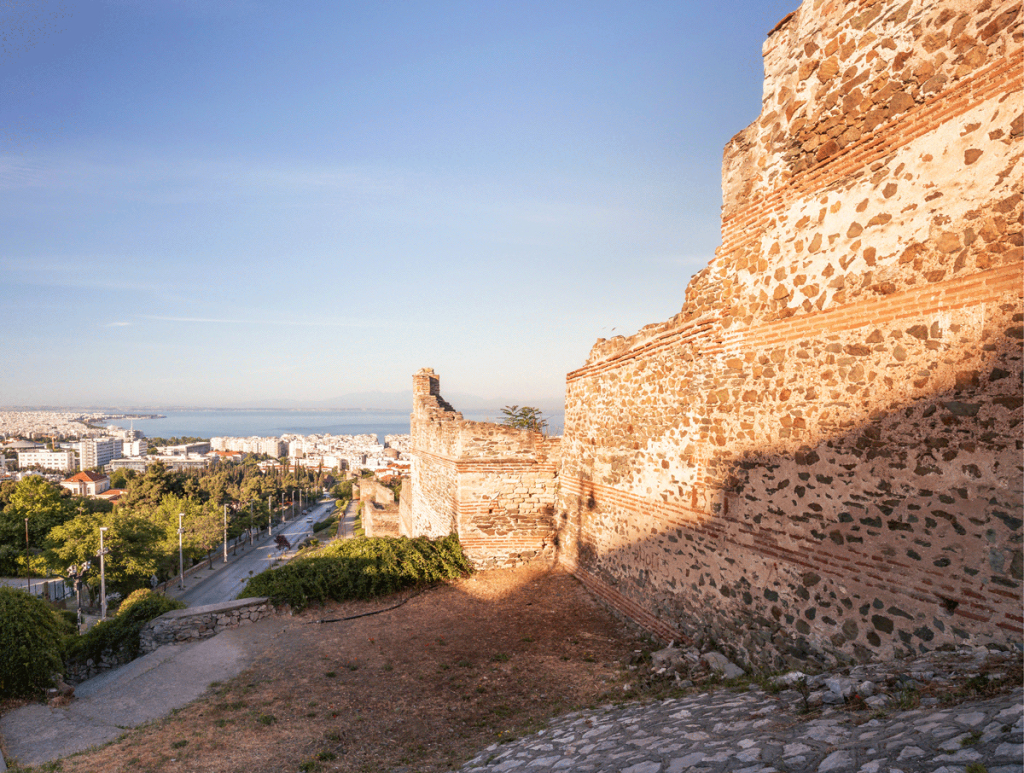
- The Byzantine Walls
The UNESCO World Heritage sites in Thessaloniki consist of various locations, including the city walls which comprise the western walls, eastern walls (White Tower), Acropolis walls, Eptapyrgion, Trigonion tower, Laparda tower, and Anna Paleologina Gate. The walls themselves serve as a historical record of the city, with inscriptions and evidence of repeated repairs and reconstructions spanning many centuries. Additionally, remains of earlier Hellenistic and Roman fortifications were incorporated into the new fortification wall in the late 4th century. In total, the city walls have a perimeter of 8 kilometers.
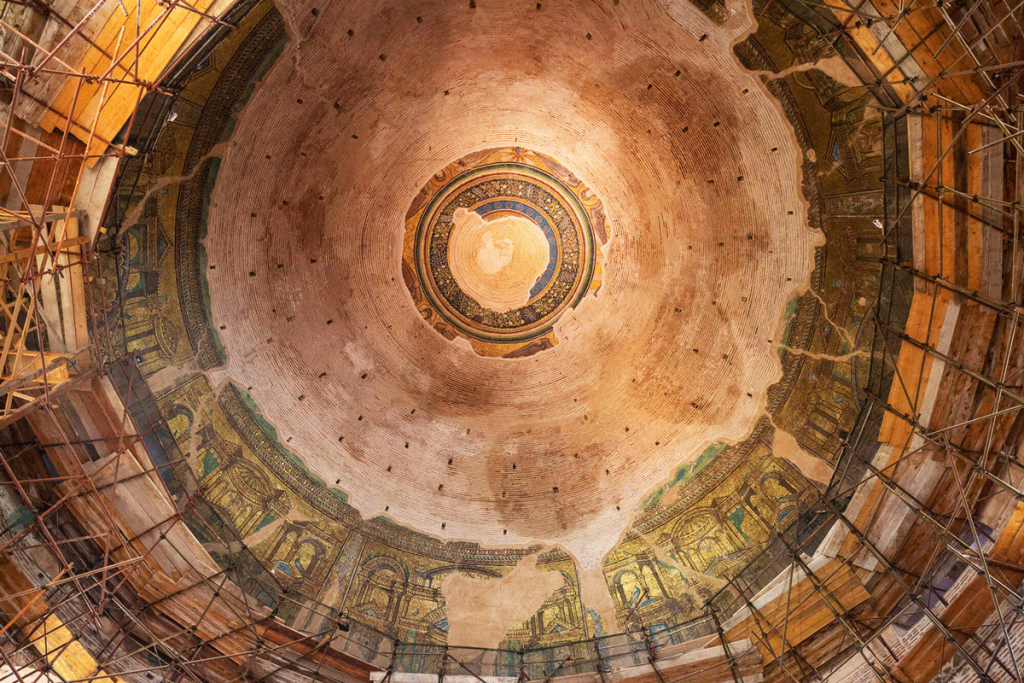
- Rotunda
The Rotunda was initially constructed as a centrally-planned building, positioned on the axis of the grand street that linked the triumphal arch of Galerius to the palace complex. The most remarkable remnants of the monument’s Early Christian era are the splendid mosaics that adorn the arches of the niches and the underside of the windows. The magnificent decoration of the Rotunda reaches its pinnacle with the three-tiered mosaic designs on the dome.
- Church of Hosios David
Located in the Ano Poli, at the end of Aghias Sofias Street, the small Church of Hosios David was once the catholicon of the monastery of Christou Sotira tou Latomou, named after the stone quarries in the area. The church was built in the late 5th century in the cross-in-square style, with an apse on the east side. Today, only the eastern half of the original facade remains. The church is famous for its mosaic of the vision of Prophet Ezekiel in its alcove, one of the most important mosaics of the early-Christian era.
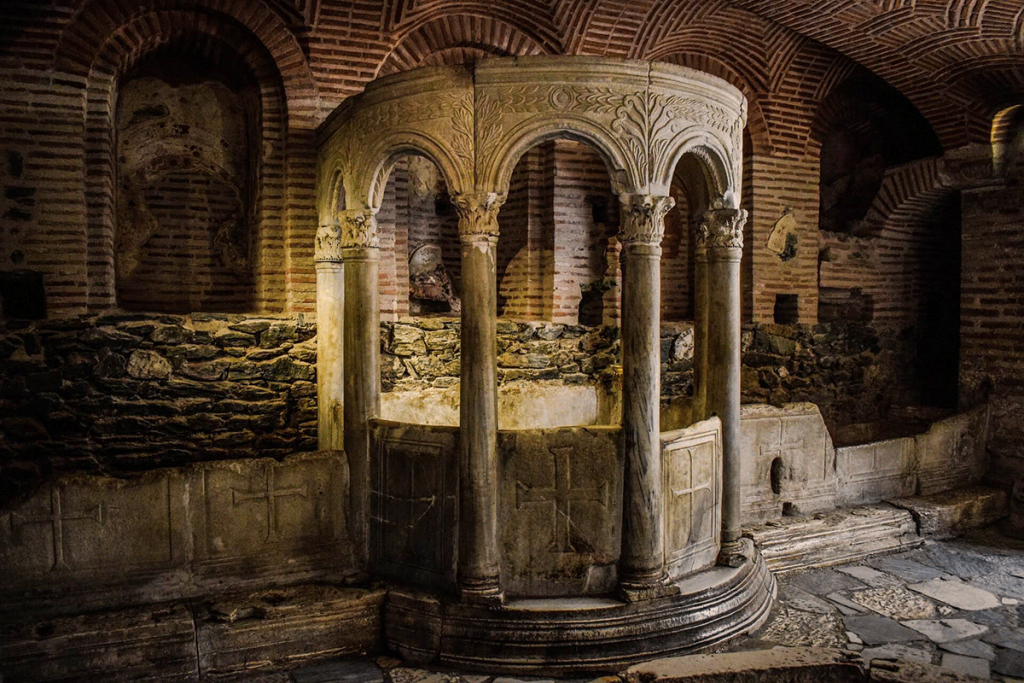
- Basilica of Agios Dimitrios – Crypt
The Basilica of Agios Dimitrios is located on Aghiou Dimitriou Street, north of the ancient Agora and the Byzantine Megalophoros. Originally a small private chapel, a large basilica was built at the same location in the mid-5th century by Leontius, the prefect of Illyricum. It burned down during the earthquake of 620 and was later restored as a five-aisled wooden-roofed basilica with a transept. Beneath the transept lies the Crypt, which was the center of the Saint’s miraculous myrrh production in the late Byzantine era. Since 1985, it has been home to an exhibition of paleo-Christian and Byzantine sculptures that showcase the history of the Basilica of Agios Dimitrios.
- Basilica of Panagia Acheiropoietou
The Basilica of Panagia Acheiropoietou, also known as the Great Church of the Virgin Mary, is located on Aghias Sofias Street in the city center. It was constructed in the 5th century as a three-aisled wooden-roofed basilica with a narthex and gallery, built over the ruins of a Roman bath complex. A small alcoved building attached to its south side served the worshiping needs of the church, while a small chapel dedicated to Agia Irene was added to the eastern side during the Byzantine period.
- Church of Agia Sophia
The Agia Sophia church, dedicated to Christ, was built in the late 7th to early 8th century over a 5th century basilica. It is a typical example of a domed transitional cruciform church with ambulatory, inspired by the Aghia Sophia in Constantinople. The interior of the church is decorated with mosaics that testify to the high intellectual and artistic level of the city throughout the centuries.
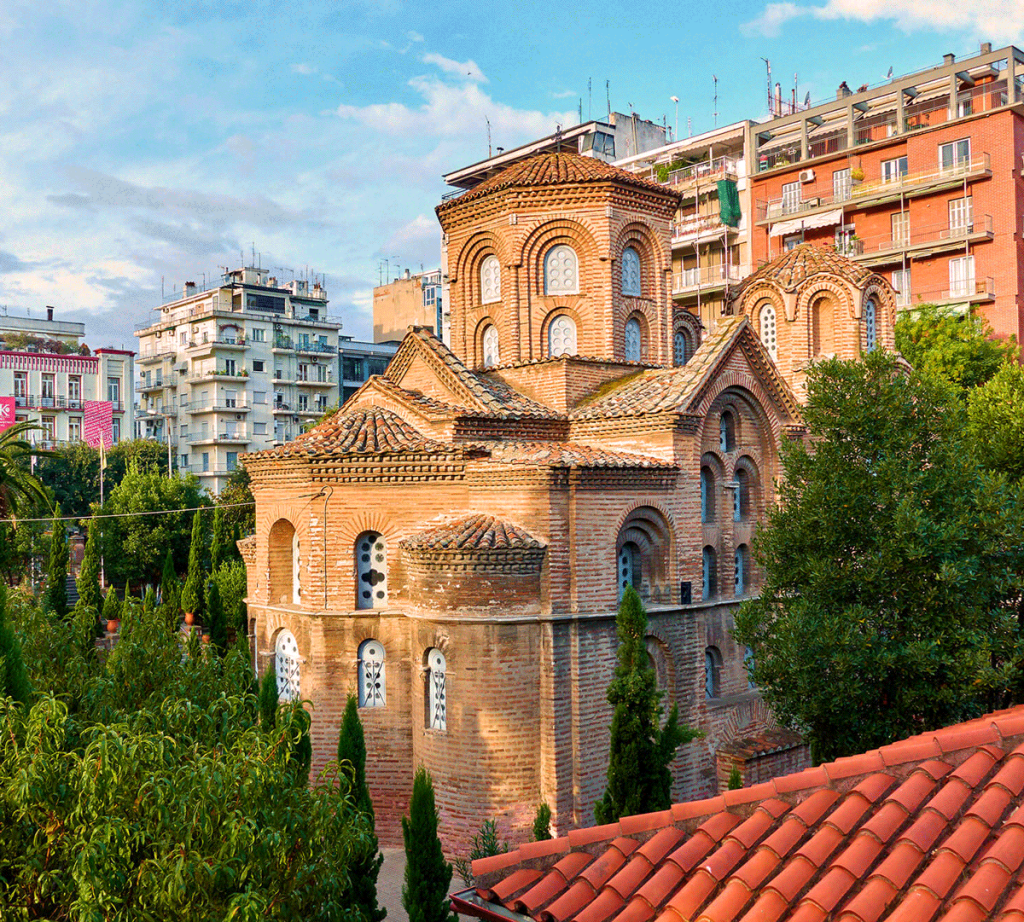
- Church of Panagia Chalkeon
The Church of Panagia Chalkeon is located south of the ancient agora, at the southeast corner of the Byzantine Megalophoros, in the entrance. The elegant proportions of the monument and its brick walls consisting of blind arches, blind niches, and half-columns are indicative of a Constantinopolitan influence. It is built in the domed cross-in-square architectural style.
- Byzntine Bath
The only public Byzantine bath currently preserved in Thessaloniki is located on the outskirts of the Ano Poli, on Theotokopoulou Street. This small rectangular building has been preserved as it was originally built.
- Church of Agios Panteleimon
The Byzantine Church of Agios Panteleimon is situated at the intersection of Arrianou and Lassonidou Streets, a short distance from the Arch of Galerius and the Rotunda. This church follows the complex domed cross-in-square architectural style with an ambulatory, which terminates in the east with two chapels. Unfortunately, only a few examples of its original murals have survived.
- Church of Agioi Apostoloi
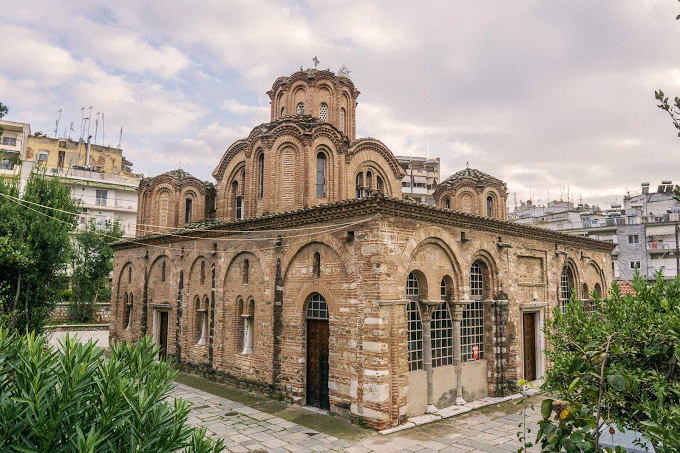
The Church of Agioi Apostoloi is located at the beginning of Olympou Street, near the western walls. It was previously the catholicon of a monastery dedicated to the Virgin Mary, built by Patriarch Nephon (1310-1314) and his pupil, Abbot Pavlas. The church follows the complex five-domed tetrastyle cross-in-square architectural style with an ambulatory. Its interior is decorated with exquisite mosaic work that is characteristic of the final period of Palaeologan art. The external facades of the monument, especially the ceramoplastic elements on its eastern side, are of great interest.
- Church of Agios Nikolaos Orfanos
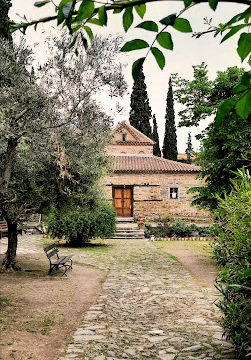
Situated in Ano Poli, between Herodotou Street and Apostolou Pavlou Street, close to the eastern walls and within an enclosed yard, is the Church of Agios Nikolaos Orfanos. This church follows the aisleless timber-roofed architectural style with an ambulatory that terminates in the east with two chapels. Its exquisite mural decoration is one of the most complete painting complexes that have been preserved in Thessaloniki, and it is representative of Palaeologan art.
- Church of Agia Aikaterini
Located above Olympiados Street, on the outskirts of Ano Poli, at the junction of Tsamadou and Oedipoda Streets, close to the northwest walls, is the Church of Agia Aikaterini. It dates back to the late 13th to early 14th century and follows the complex tetrastyle cross-in-square architectural style with five domes and an ambulatory that terminates in two chapels at the east end. Although its mural decoration has survived in fragments, it follows the painting tradition of the early Palaeologan Renaissance.
- Church of Metamorfosis tou Sotiros
The small Church of Metamorfosis tou Sotiros, dedicated to the Saviour, is located at the intersection of Egnatias and Paleon Patron Germanou Street. Built in 1340, it may have served as a sepulchral chapel for a Byzantine monastery and was originally dedicated to the Virgin Mary. The church’s architectural style is characterized by a tetraconch inscribed in a square plan. Unfortunately, the western conch was demolished in 1936 to make room for a narthex. The church’s mural decoration, which is part of the Palaeologan tradition, dates back to 1350-1370.
- Vlatadon Monastery
Vlatadon Monastery is located immediately outside the walls of the Acropolis, on Acropoleos Street. It is the only Byzantine monastery that still holds services in the city. The monastery was founded between 1351 and 1371 by the monk Dorotheus Vlatis, a pupil of Gregory Palamas, who later became the Metropolitan of Thessaloniki. Only the catholicon of the original complex survives, which follows the cross-in-square architectural style with an ambulatory that terminates in chapels. The mural decoration in its interior dates between 1360 and 1380.
- Church of Profitis Elias
The impressive Church of Profitis Elias stands on a naturally rocky elevation at the junction of Olympiados Street and Profiti Elia Street. It is a unique architectural masterpiece in Thessaloniki, featuring a tetrastyle cross-in-square plan with a narthex and an ambulatory leading to two chapels. Although much of its iconographic decoration has been lost, the portrayal of the Infanticide, which is representative of the final period of Palaeologan painting, can still be seen in the narthex.