
15 UNESCO monuments in Thessaloniki
Learn about the fascinating history of Thessaloniki over the centuries through its 15 monuments that have been included in the Unesco World Heritage List. These sites were included in the Unesco catalogue in 1988 and date from the early Christian period (4th century AD) to the late Byzantine period (13th-14th century). Visit them, explore them and admire unique relics or frescoes that add glamour to the unique and great history of the city.
1. The Walls of Thessaloniki
The Walls of Thessaloniki originally had a perimeter of 8 km and were constructed during the 4th and 5th centuries. At Dimokratias Square, part of the western Walls is preserved, while the main entrance to the city, called the Golden Gate, used to be located there. The Walls also extend to the north-west and even higher are the Walls of the Acropolis, the Gate of Anna Paleologina and the Triangle Tower, while part of the eastern Walls are preserved, ending at the White Tower. Finally, the fortress of Heptapyrgion is located at the highest point of the Acropolis and parts of it were built in various periods from the early Christian era to the Turkish occupation. The Heptapyrgion was originally constructed with 10 towers and its name is probably due to a similar construction in Constantinople called Heptapyrgion (7 towers).
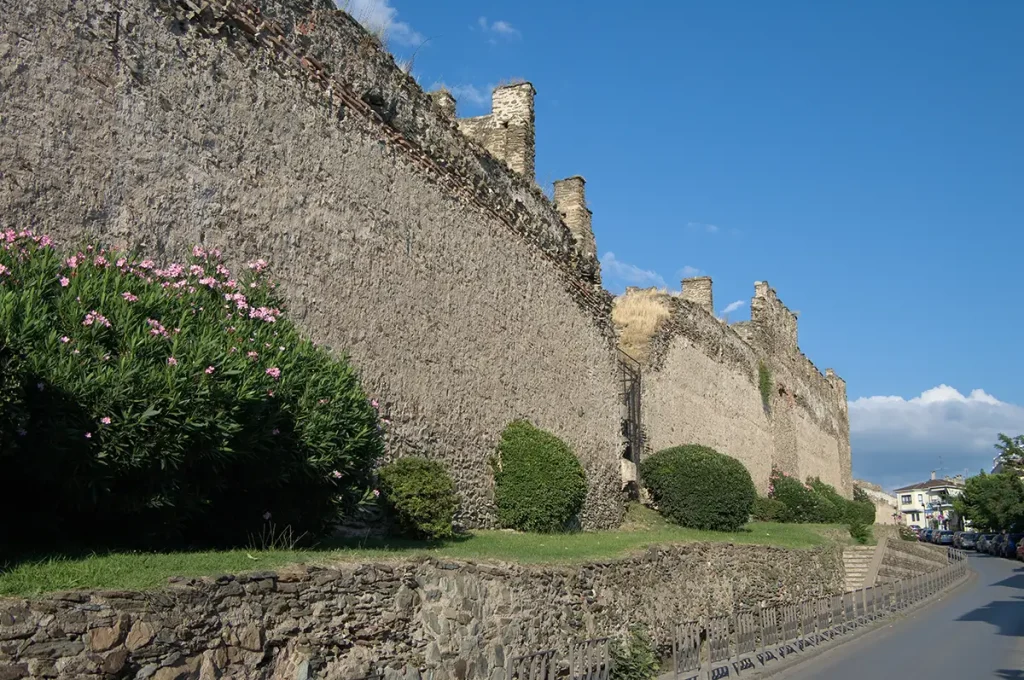
The walls
2. Rotunda or Church of Agios Georgios
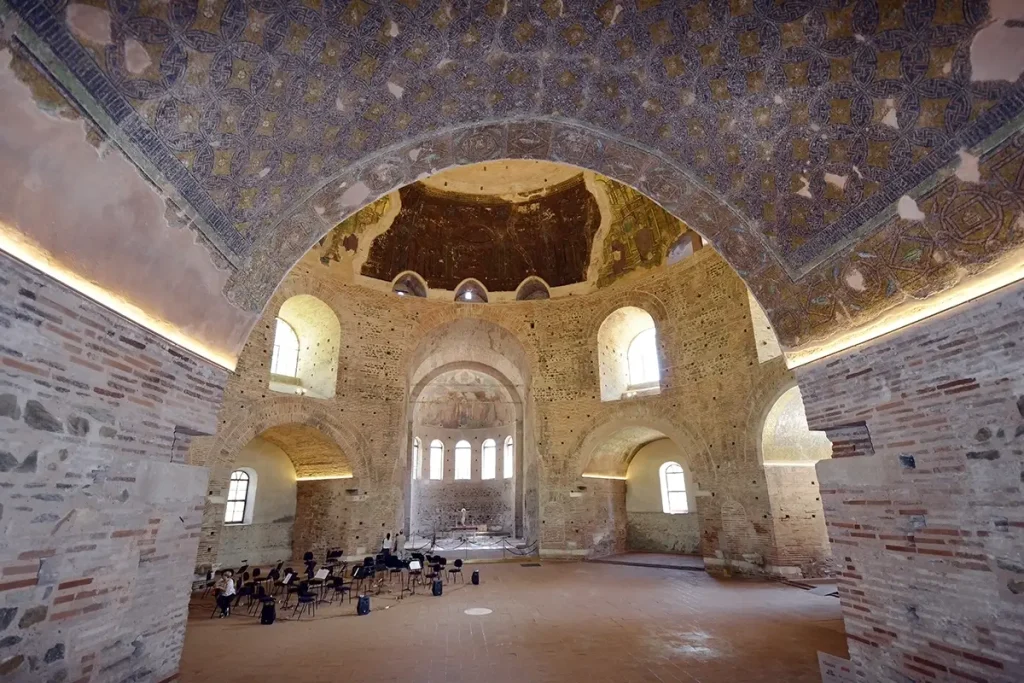
The Rotunda owes its name to its circular shape and was built in the time of Caesar Galerius (4th century), probably as a temple of Zeus or as a mausoleum. It was converted into a Christian temple in the early Christian years and impressive mosaics were created in its premises, while for a time it also functioned as a Muslim mosque. However, after the liberation of Thessaloniki it was dedicated to Saint George. The monument has suffered considerable damage over the centuries from earthquakes, but extensive restoration work has been carried out, both to strengthen its stability and to preserve its exceptional decoration.
3. Basilica of Saint Demetrius & Crypt
The church of Saint Demetrius is located north of the ancient Agora and was built on the ruins of a Roman bath complex, a place where the Saint had martyred. The basilica was built in the 5th century by the provincial governor of Illyricum, Leontius, burnt in 620, but was restored and looted at least twice by the Saracens and the Normans. In 1493 it was converted into a mosque by the Turks, destroyed in the great fire of 1917, but rebuilt again, and the beautiful mosaic sets that survived stand out. It is worth noting that below the church is the Crypt, which in the late Byzantine period was the centre of the saint’s myroblicity. Today it functions as a museum with amazing exhibits.
4. Church of Hosios David (Latomou Monastery)
In Ano Poli and specifically at the end of Agia Sophia Street, there is the church of Hosios David, also known as the Latomou Monastery, a name that is believed to be due to the stone quarries that existed in the area. The church was built at the end of the 5th century and is extremely well known for the magnificent mosaic in the niche, which depicts the vision of the prophet Ezekiel and is considered one of the most important works of the early Christian period. The monastery became a mosque during the Turkish occupation and when it was reopened as a Christian church in 1921, it was dedicated to Hosios David.
5. Church of Holy Apostles or Agioi Apostoloi
The Church of the Holy Apostles is located at Olympou Street and very close to the western Walls of the city, and it is estimated that it was the katholikon of a monastery dedicated to the Virgin Mary, founded by Patriarch Niphon (1310 – 1314). Inside the church there are amazing mosaics, characteristic of the last period of Palaeologan art. Around 1520 – 1530 the monastery was converted into a mosque and the mosaics and frescoes were covered up. The name Holy Apostles was given in the 19th century, and from 1926 onwards work began on the gradual uncovering of the frescoes. Also, the mosaics have now been cleaned and restored and can be admired.
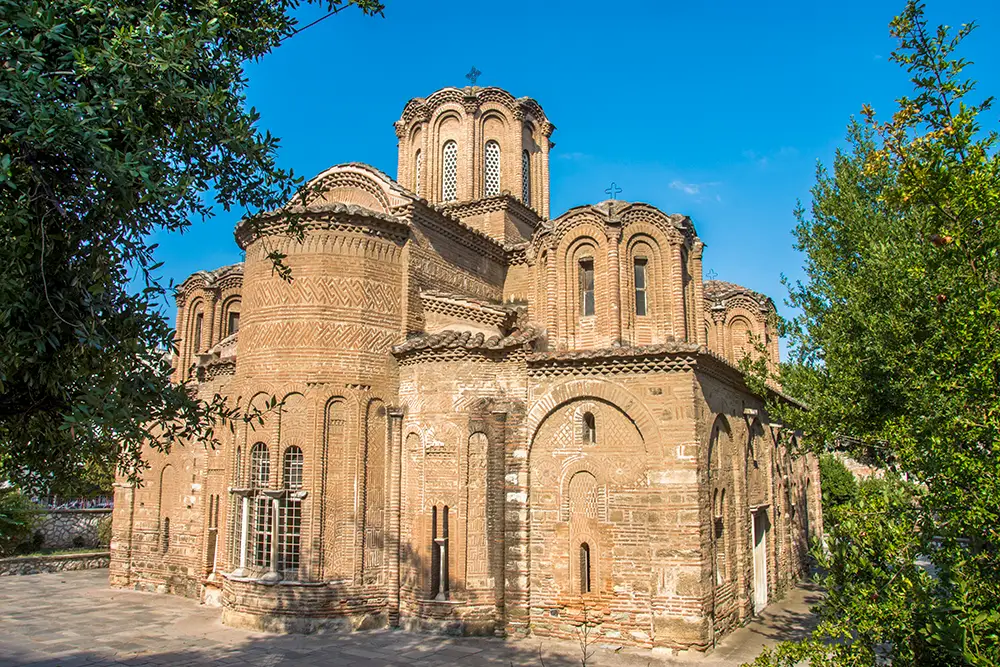
Agioi Apostoloi Church
6. Church of Agia Sophia or Church of the Wisdom of God
This particular church is dedicated to Christ and the Wisdom of God and was built in the late 7th – early 8th century on the model of Agia Sophia in Constantinople. Earlier, on the same site was an early Christian Basilica church of the 5th century, which was destroyed by an earthquake. The mosaics of the church were created in three different periods. In fact, the composition of the Ascension, located on the dome and dating from the late 9th century, is a prime example of the “Renaissance of the Macedonian Emperor era”. The church was at various times a Latin cathedral and a mosque, but in 1913 the site was re-consecrated and given to the Christians of Thessaloniki.
7. Church of Agios Panteleimon
At the junction of Iasonidou and Arrianou streets, very close to the arch of Galerius, is the Byzantine church of Agios Panteleimon. This particular church was the katholikon of a monastery, which was dedicated to the Virgin Mary and was a spiritual center in the 14th century. The church, like many others, was converted into a mosque after the mid-16th century and many of its sacred vessels were transferred to a neighbouring chapel dedicated to Saint Panteleimon. This is how it is speculated that eventually this particular Byzantine church acquired its name. It is worth mentioning that the base of the minaret, which was built by the Turks, who also made other changes, is preserved in the area.
8. Basilica of Virgin Mary Acheiropoietos
The Basilica of Acheiropoietos, located in the centre of Thessaloniki, was built around the middle of the 5th century. The church was built on the ruins of a Roman Bath, which is thought to have been an extremely important public building in Thessaloniki. As for the name of the church, written sources refer to it as the great temple of the Virgin Mary, while the name Acheiropoietos is probably related to an image of the Virgin Mary praying. The Basilica of Acheiropoietos is the first Christian church in Thessaloniki that was converted into a mosque after the fall of the city by the Turks in 1430 and was their official mosque, also known as the “old mosque”.
9. Byzantine Baths
In Ano Poli and specifically in the Koule Kafe district is the largest Byzantine bath, which is preserved today in the whole of Greece and the only one that has been saved in Thessaloniki. It is a rectangular building of relatively small dimensions and served both men and women. This particular bath, which was probably built in the 13th century, operated for at least seven centuries. In fact, it was still in use during the Ottoman period and was used by Muslims, who made several changes to bring it into line with their religious traditions.
10. Church of Saint Catherine
Above Olympiados Street in Ano Poli and near the northwestern Walls of Thessaloniki is the church of Saint Catherine, which used to be the katholikon of a Byzantine monastery. It was built in the late 13th – early 14th century and was dedicated to Saint Catherine after the liberation of Thessaloniki in 1912. It is assumed that the monastery that existed on the site was dedicated to Jesus, as there are many frescoes in the church with themes from the miracles and life of Christ. The temple has also undergone many interventions especially after its conversion into a mosque. At that time a minaret was also built, which was demolished after the liberation of the city.
11. Church of Panagia Chalkeon
The church of Panagia Chalkeon is located in the center of Thessaloniki at the intersection of Egnatia and Aristotelous Streets, in the neighbourhood of the Chalcomatades (coppersmiths), from where it took its name. The church was built in 1028 in honour of the Virgin Mary and has clear influences from Constantinople, while the people had given it the name «the red church», resulting from the use of plinths for its construction. The church had frescoes at the time of its construction, but the decoration was renovated during the Palaiologan period and new frescoes were made.
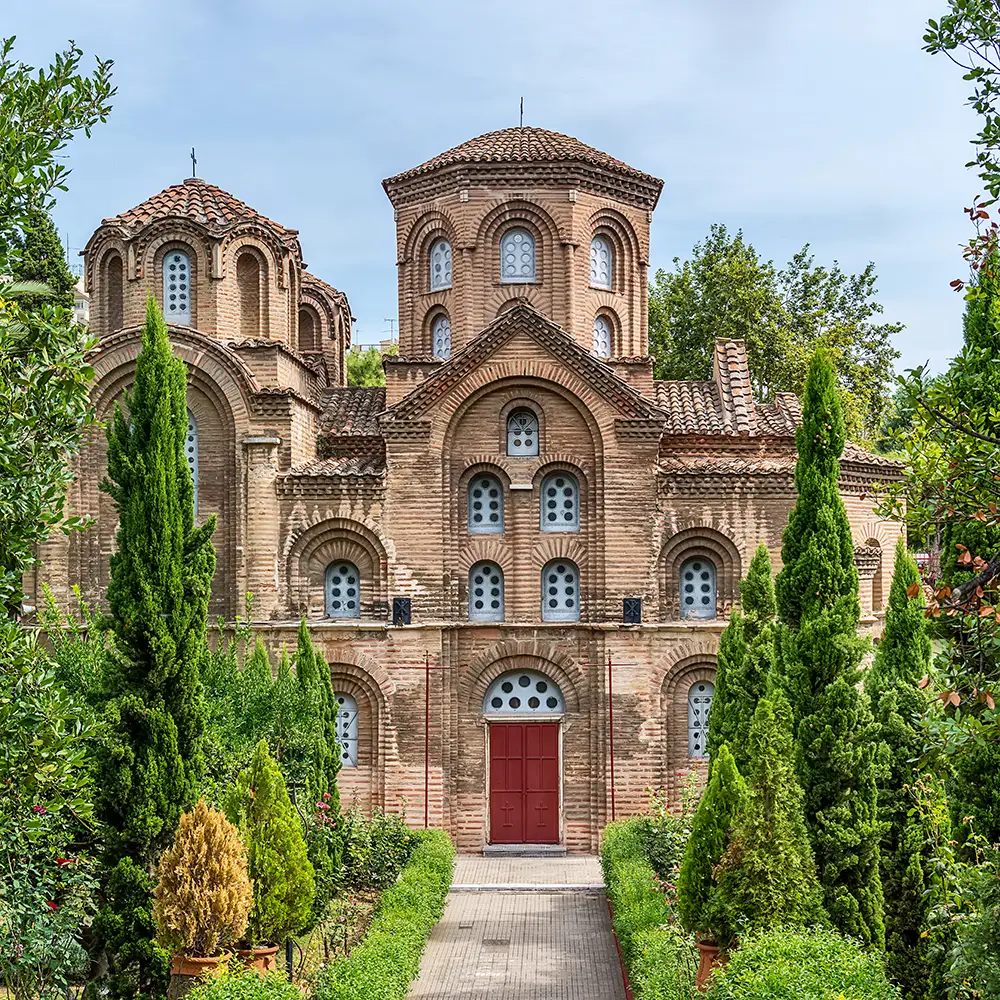
Panagia Chalkeon Church
12. Vlatadon Monastery
The Vlatadon Monastery, a Byzantine convent, which is still functioning today, is located just outside the Walls of the Acropolis. It was founded between 1351-1371 by the student of Gregory Palamas, the monk Dorotheos Vlatis, later Bishop of Thessaloniki. The church was originally dedicated to Christ Pantocrator, but today it is dedicated to the Transfiguration of the Saviour. The monastery was sponsored by the empress Anna Paleologina. It is extremely important that after the occupation of Thessaloniki by the Turks in 1430, the monastery continued to function as an Orthodox convent.
15. Church of Agios Nikolaos Orphanos or Saint Nicholas Orphanos
This church is also located in Ano Poli, between Herodotus and Apostle Paul streets and very close to the eastern Walls of the city, while it is estimated that it was the katholikon of a Byzantine monastery (14th century). The fresco decoration of the church is considered to be a masterpiece and is one of the most complete preserved paintings in Thessaloniki and a representative example of Palaeologan art. The frescoes of the temple are a work of the mature Palaeologan Renaissance associated with the artistic circle of the painters from Thessaloniki Georgios Kalliergis, Michael Astrapas and Eutychios. It is worth noting that the monastery continued to operate during the Ottoman occupation.
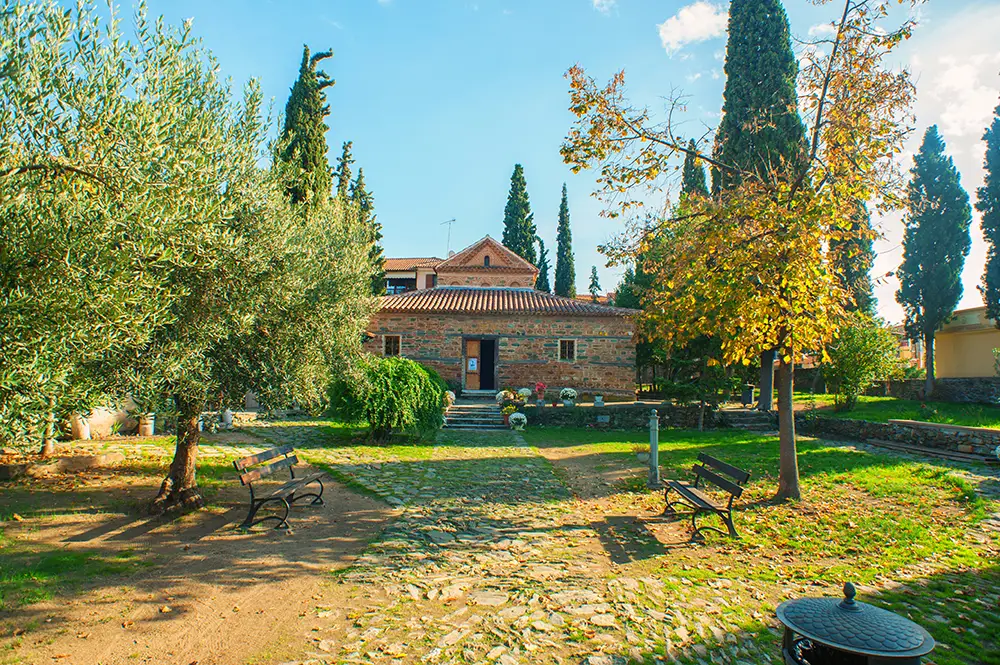
Agios Nikolaos Orfanos Church
13. Church of Transfiguration of the Saviour (Metamorphosis tou Sotiros)
The church is located at the intersection of Egnatia and Palaion Patron Germanou streets, was probably built after 1340 and is estimated to have been a funerary chapel of a Byzantine monastery and was originally dedicated to the Virgin Mary. In fact, it is believed that it was not converted into a mosque during the Turkish occupation, as it was quite small. Inside the dome there is a fresco depicting the Ascension of Christ, while of particular importance is the fresco at the base where there is a depiction of the Divine Liturgy with Christ surrounded not by angels, but by hierarchs, chanters and believers.
14. Church of Prophet Elijah
The small church of Prophet Elijah (14th century) in Olympiados Street is unique in Thessaloniki, because of its special architecture, known as Athonian. It can be easily spotted because it is located on a natural hill and in the past it dominated the surrounding area. It is speculated that it used to be dedicated to Christ and was probably the katholikon of a Byzantine monastery. Of the iconographic decoration, only the depiction of the Infanticide survives, representative of the last phase of Palaeologan art.
15. Church of Agios Nikolaos Orphanos or Saint Nicholas Orphanos
This church is also located in Ano Poli, between Herodotus and Apostle Paul streets and very close to the eastern Walls of the city, while it is estimated that it was the katholikon of a Byzantine monastery (14th century). The fresco decoration of the church is considered to be a masterpiece and is one of the most complete preserved paintings in Thessaloniki and a representative example of Palaeologan art. The frescoes of the temple are a work of the mature Palaeologan Renaissance associated with the artistic circle of the painters from Thessaloniki Georgios Kalliergis, Michael Astrapas and Eutychios. It is worth noting that the monastery continued to operate during the Ottoman occupation.